
Colby Vexler
Colby, please introduce yourself:
I am a designer based in Melbourne, Australia. I admire buildings and maybe their interiors even more, or at least more so for now. My practice focuses on this admiration more than a defined scope. So I take photos of them, have renovated some and am currently furnishing a few more.

Letting Things Rest, a modest exhibition of work in progress by Andrew Power, Kate Finning, Jean Marc Tang, Ieva Davulyte & Colby Vexler. March, 2025
#1 You operate at the intersection of design, art direction, and interior architecture. What initially drew you to working across these three fields, and how do they inform and enrich one another in your daily practice?
I’ve never felt particularly comfortable with titles. I do love the idea of practice though. Maybe it’s indecisiveness, but more recently I’ve started to think that this might just be part of an approach to eclecticism. I’m interested in being able to work on projects without needing to re-title myself. I don’t want to claim expertise where I am lacking or pretend that I’ve arrived at something I’m still working through.
There are probably fitting terms, but in my over-thinking, they tend to list the type of work I’ve done more than articulating the work itself. I don’t really see making photographs as being so different from furnishing a room, or designing a shop. I like thinking about the arrangement of things more so than titling my role in making them.
I also like working with people; for a long time, and still with Rory Gardiner taking photographs, and more recently and often with Kate Finning on built works and exhibitions, Louis Horne making images and a few proposed works, and with Charlie Eastwood on almost everything at the moment. I discuss every project with Sora Graham, Andrew Power and Guillermo Fernández-Abascal. I rarely do things on my own, or maybe never really have. I like having trust in others’ expertise; it refines a trajectory that couldn’t have otherwise been developed.
I think genuine eclecticism is neither randomness nor scope expansion for its own sake, but a practice governed by taste, self-discretion, tradition, order and principles, and an understanding of these things that comes from continuing to work with them. I’m not particularly science-y, but I like the idea of evolution over re-invention.
Perhaps that is what I mean by a practice: some consistency in the approach, without the things that come out of it needing to be particularly consistent.
#2 Your design process relies on drawings, physical models, and collages. How did this distinct visual methodology evolve, and how does it drive your conceptual thinking compared to purely digital tools?
I often feel I initiate early work with what’s on hand, including intuition. I think there is a rigorous naivety across the tools I am drawn to. I spend a lot of time thinking about how things can literally be expressed, be it a door detail or a cupboard. So far, a simple pencil sketch, basic 2D documentation and even more simplified 3D modelling have allowed some of those proposals to become built work. It’s not that I am against advanced tooling; I just haven’t felt compelled to explore it. Maybe one day I will, but if I do I hope the work doesn’t feel unnecessarily complicated.
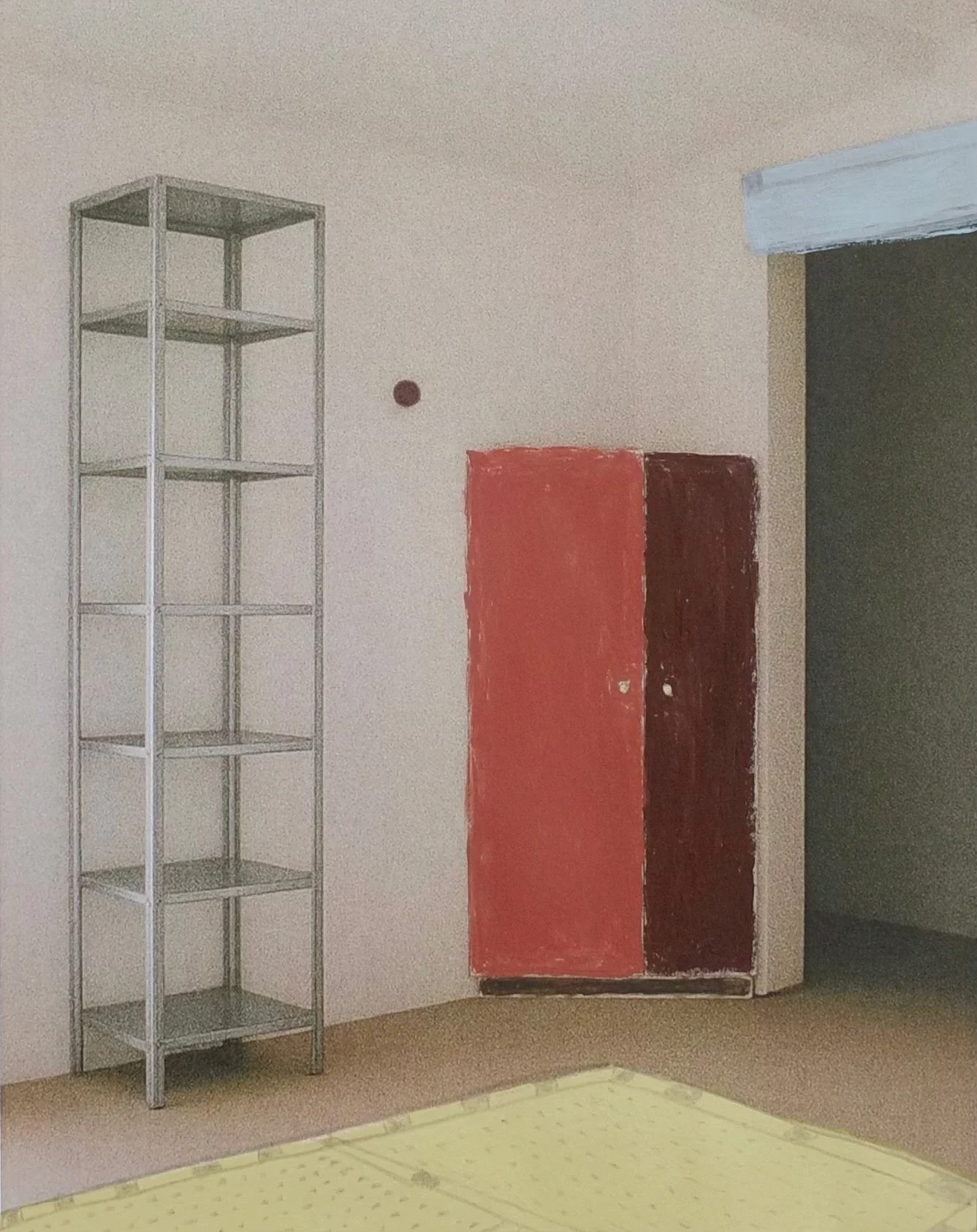
A guest room in Shimokitazawa 2025
#3 You recently curated the exhibition A Drawer Column. How did this project come about, and what excites you about curating spatial experiences compared to designing physical interiors?
The Drawer Column was a work I assembled as part of an exhibition I co-curated with Marsha Golemac for MUJI Australia, titled MUJI.
Marsha invited me to be involved. From early ideation to final outcome, it felt effortlessly intuitive working together. Marsha invited a group of artists and designers to partake in the show. MUJI allowed Marsha and I to borrow a long list of items, and we then spent a few days together arranging what had been made by the contributors and what had been dropped off by MUJI. The works and MUJI products sat together, sometimes side by side, or indistinguishably on one another. The gallery setting allowed some things to still feel definable in their object-ness, or utility value, others less so. I like what re-contextualisation can do.
Maybe everything should have the opportunity to be freed from its usual routine. Not to be re-invented but admired for its own qualities. Proust said that Chardin had the talent to make us fall in love with a loaf of bread on a kitchen bench. His painting imbued a typical domestic configuration with a charming-ness, not meaning.
Kazuo Shinohara would choreograph a set of photos before handing over the keys to a house he designed. He described this as the final architectural act, or of Fictional Reality. He didn’t intend for the prospective homeowners to live like this but speculated on a possible configuration of furnishing. I think I read somewhere that he saw this as a final way of understanding what had been made, both literally and experientially. I like when this distinction doesn’t seem too apparent, or when it doesn’t need to be explained, it is just understood.
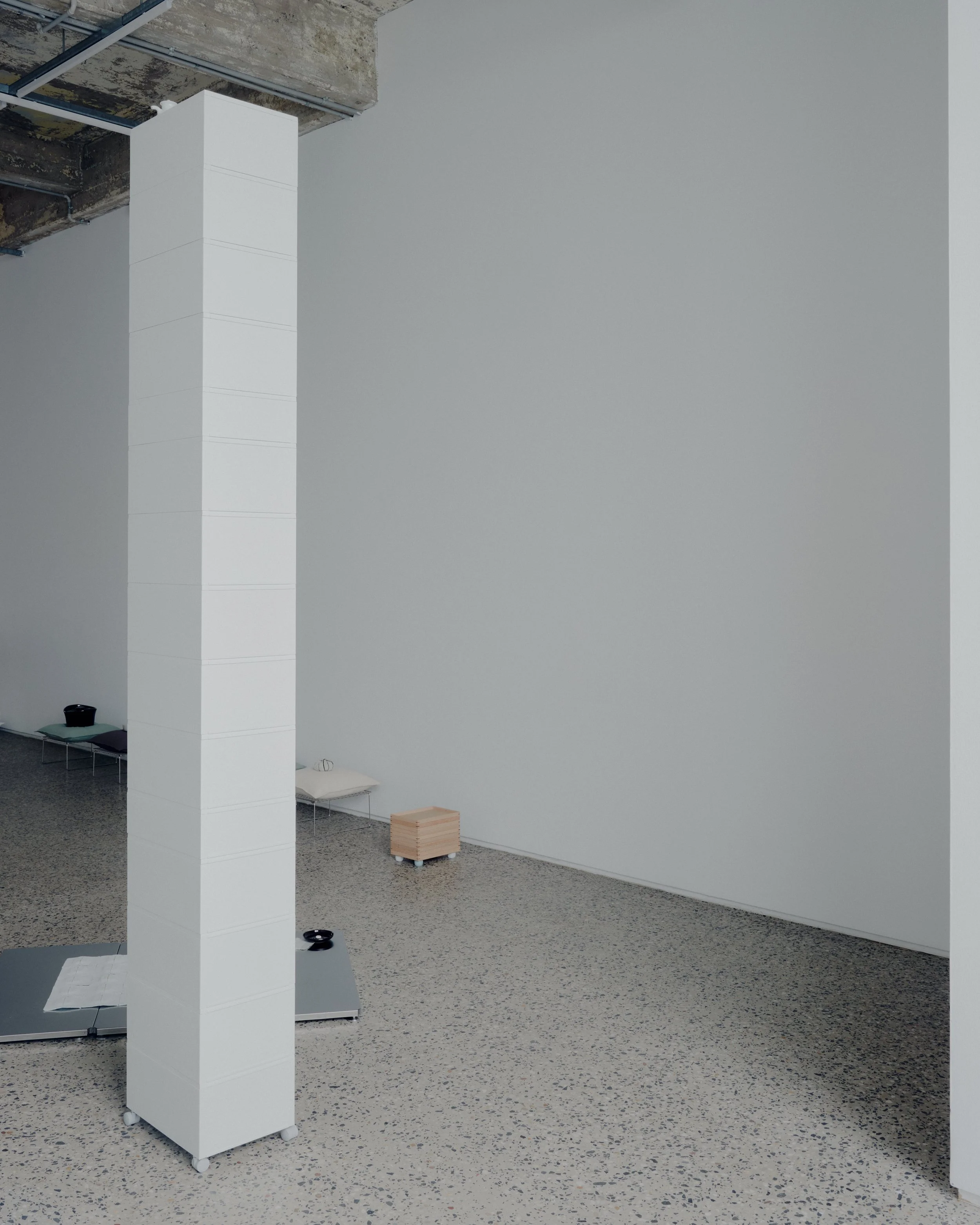
Muji Made, A Drawer Column © Pier Carthew
#4 In your Ground Floor Apartment project, you implemented minimal, highly targeted interventions that take on a distinct, object-like character. How do you approach developing a concept like this, and how do you decide where to make an intervention?
This was a study for a project which hasn’t been built and might not ever. It was a collaboration with my friend and colleague Louis Horne. There was the possibility to “re-do” the existing floor slab and re-instate, but not move, existing windows. An ornamental fireplace hood, a hearth stone and wall stone inlays, and a shallow medallion-like intaglio into the proposed floor screed were all embellishments, but not secondary thoughts. Part of the project sat at the discretion of Owners Corporation, the other half sat with the clients. We felt the apartment’s living room’s original hierarchy could be re-arranged without the room itself being re-configured. We liked the idea of altering character. We didn’t see these as disparate parts or features but re-expressions. An empty corner became gravitational, a bare slab received the subtle grandeur typically given to stone or marquetry flooring.

A ground floor apartment with Louis Horne 2024 © Indicative Pictures
#5 Certain tones, like pale yellows and muted, earthy reds, seem to reappear thoughtfully throughout your portfolio. What role does color play in your spatial storytelling, and how do you select your palettes?
Without trying to overthink it, I find it funny that I recently decided that my favourite colour is DULUX Half Hindsight. I like the colour, but its name seemed to make it even better.
To extrapolate meaning from colour itself might give it further value, but it is almost always codified, in part by lore, and in part by the unity of a subjective taste.
“Colour of the year” forecasts reaffirm a collective consensus. They tell us what we like, or what we should like. Sometimes I agree, consciously or otherwise. Other times I feel reactionary, consciously or otherwise.
It’s not that I don’t believe in the value of colour, but I believe more so in the value of their expressions, on their own terms and in the accompaniment of other colours - their colleagues. They can cooperate through orders: accents, motifs, highlights - a shared language of their own. I don’t want to speak on their behalf, or imbue them with meaning, but borrow from them and settle on developing an intuition that tells me when these choices feel right.

A brief display of casual furnishing drawing from an exhibition with Sora Graham 2024
#6 What's next for you? What projects are you currently working on, and is there a specific typology, scale, or medium you are eager to explore in the future?
I’m not sure, but for now I am working on several built works. Again, all collaborative and varied in scope. Kate Finning, who I mentioned earlier, and I are working on the refurbishment of a public hall, and I am also helping Kate with the renovation of Federation House. Both these projects are in Melbourne. I am also working on the interiors for a house in Berlin, wall panels for an artist’s apartment, and some minor works for a gallery, both in Sydney. Charlie Eastwood has been involved in all these projects. Rory Gardiner and I are working on a photography book and an exhibition too, and have several shoots coming up.
I hope I can continue to work across such projects in the future. Not to iron out my titles, but to further clarify a trajectory I am hopefully pulling together, even if it’s overly eclectic and not instantly nameable.

Art direction for the Former offices of Edmond and Corrigan for the Naarm Architecture Foundation 2026 © Rory Gardiner
#7 How do you see the role of an architect in today's society?
There is a long-standing history here. There is so much to revisit and learn from rather than constantly re-invent. I’ve never really seen myself as a reformist, or any “-ist” for that matter, but I think continuing things can be a minor way to change them. Revisiting doesn’t have to mean looking backwards stylistically. Sometimes it is just a way of understanding what is still there.

Some minor work for a modest shop 2025 © Rory Gardiner
#8 How does your environment influence your work?
I spend most of my time looking at things, like almost anything. I am not sure why I am drawn to certain things, but I like to speculate on how they could be altered, even just a bit. Maybe it’s a form of admiration. Design projects, at times, allow for these admirations to be reconfigurations. It’s not that I think everything has to be highly referential or drawn from a kind of vernacular approach, but I prefer to be considerate, arriving at a position through an informative-ness rather than sheer inventive-ness. Looking around seems to almost always help appease this internal doubt.
#9 Three things that inspire you at the moment?
A-typical but not overly complicated and always easily accessible specifications, a long list of things I admire, and an even longer, and continually expanding list of practitioners I admire, colleagues and those more distant alike.
#10 What do you currently read, watch, listen to?
I constantly have several partially read books around and even more tabs opened. It’s a problem. Same with YouTube, always documentaries and lectures. My film knowledge is awful. Bizarrely, I re-listen to the same music for a while before moving on or coming back. For the last few months it’s Susumu Yokota. Maybe the question has sparked some pseudo self analysis but now I think I’m dwelling on his music as a romanticised view of the eclecticism I am seeking in my own practice.

Art direction for Apartment Park by Nile Greenberg © Rory Gardiner
Links
Instagram: @url.cv
Website: colbyvexler.com
Interview by Caroline Schulz