
Dilara Koz
Dilara, please introduce yourself:
My practice spans installations, artists' books, workshops, performance-lectures, and commissioned work across photography, graphic design, creative direction, and typography. I move between the observation of space and its documentation, often creating derealised images that disrupt the conventional definition of their contents, and installations that explore atmosphere through light, colour, material, and mood.
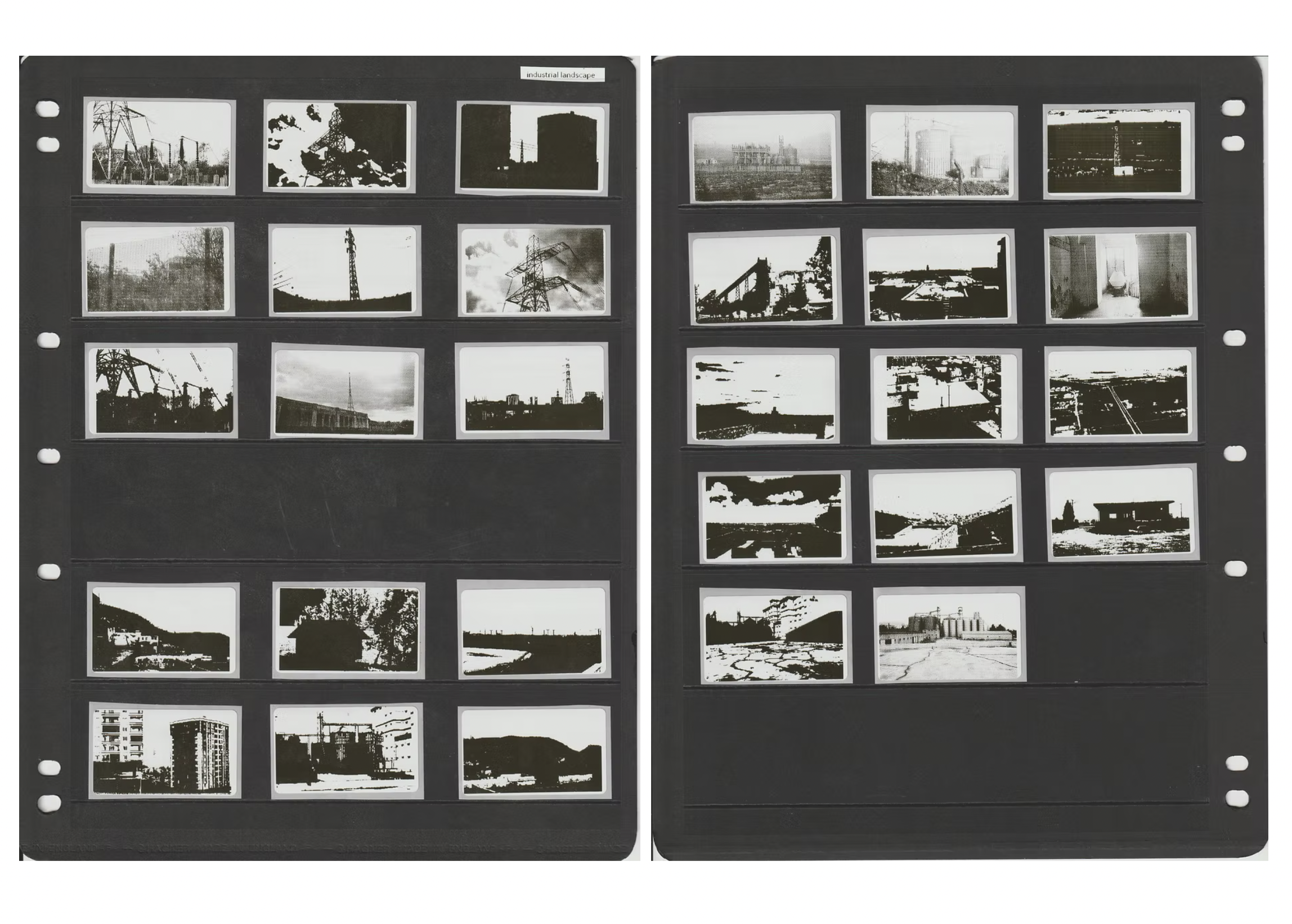
Archive of Thermal Impressions, 2023-2024, 330x287x 60mm, archival ring binder, double sided stock sheets, divider pages, approx. 1,000 30x50mm barcode stickers
#1 Could you tell us about your educational and creative journey, and how it has shaped the way you approach your practice and perceive the everyday world?
I moved to London from Ankara as an eighteen year old to study architecture. It was a transformative experience in all aspects, but it especially changed how I see and experience the world. I became very interested in perception and phenomenology: how we understand space through our senses, how we relate to it, and how we respond to it. These questions seemed very obvious to me, as the student of a discipline creating and negotiating spaces for existence, but they actually were not addressed so much in my course.
Following my undergraduate, I worked for a year at an architecture studio I admired. By the end of that year, I was certain that I didn’t want to design buildings and that led me to study art. I was still interested in the same questions, but I felt the urge to think and make in a different framework.
There are many sides to architecture. For me, it is a lens through which I see the world, and that is still with me everyday. I think I’ve also carried several methods that exist within architecture over to my art practice, which is perhaps why architects are often drawn to my work.
#2 When you are out observing and documenting spaces, what are the go-to tools, mediums, or techniques you rely on the most to capture the atmosphere?
If I am somewhere alone, my camera often feels like my companion. If I am somewhere to document, it is as if my field of vision is reduced to the frame of my camera. I see something, I show it to the camera, an image is made, and it speaks back to me. Nothing is the same seen through the camera's aperture. There is always something more or something missing.
I use a variety of cameras. I have the camera on my phone, which is an iPhone SE, it’s unfortunate because it has an “intelligent” camera that updates the photo once its shot. I have an Ushining flip phone that I use occasionally in lieu of my iPhone and it has a brilliant camera. I have a Sony HDR with which I take videos then extract stills. I have a Nikon DSLR because it was the cheapest DSLR at Jessops the year I moved to London. I have an Olympus digital camera that has some fun filters and is very quick to use. I have a Minolta 35mm camera that is a compromised replacement for my first film camera, and I occasionally make pinhole cameras.
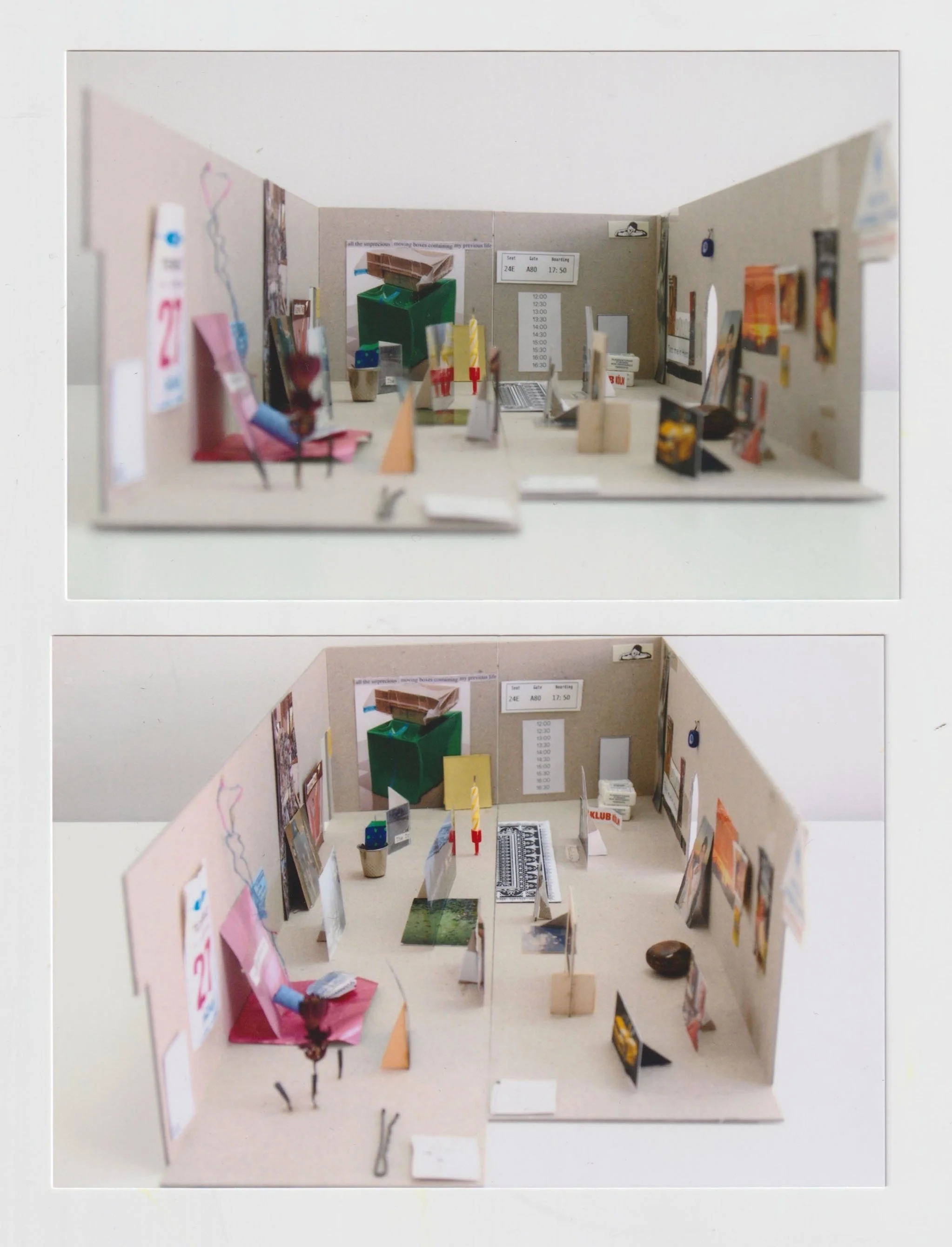
Proposal/Concept Model, 2026
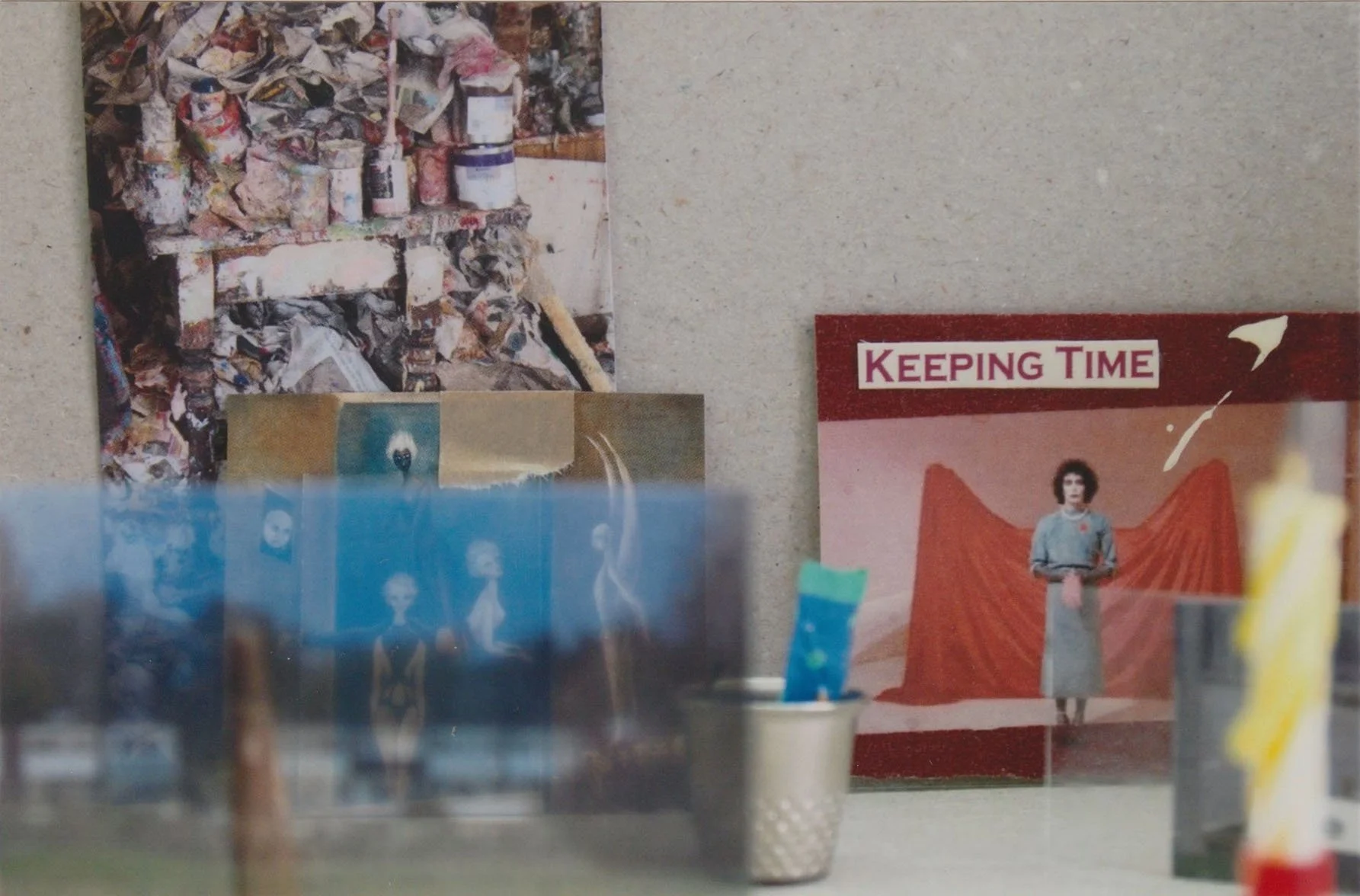
Proposal/Concept Model, 2026
#3 How does a new project usually start for you; is it triggered by a specific place, a material detail, or a random idea?
The majority of my works are rooted in place, but this can be for several reasons. Sometimes a place speaks to me and other times there is an opportunity. Idea has almost always followed place for me.
However, since the start of 2026, I decided to change my relationship to my practice. Maybe because of my background in architecture, I had bit of a “project-based” approach to my art practice. This was also because there were many projects I was working on, many back to back deadlines. I had deadlines before I had a practice, so I didn’t really feel like I had a practice outside of the projects. The projects were all connected, of course, and therefore they formed a practice. But, I wanted to change how I work so that there was something going on — an investigation, an undercurrent, a stream of thoughts, a research — outside of the deadlines.
Since the start of the year, I am thinking about frames and framing, both literally and conceptually, as a punctuation device in the discourse of art. So, now I have a question that I’m working with and the place might become secondary (while remaining very important.)
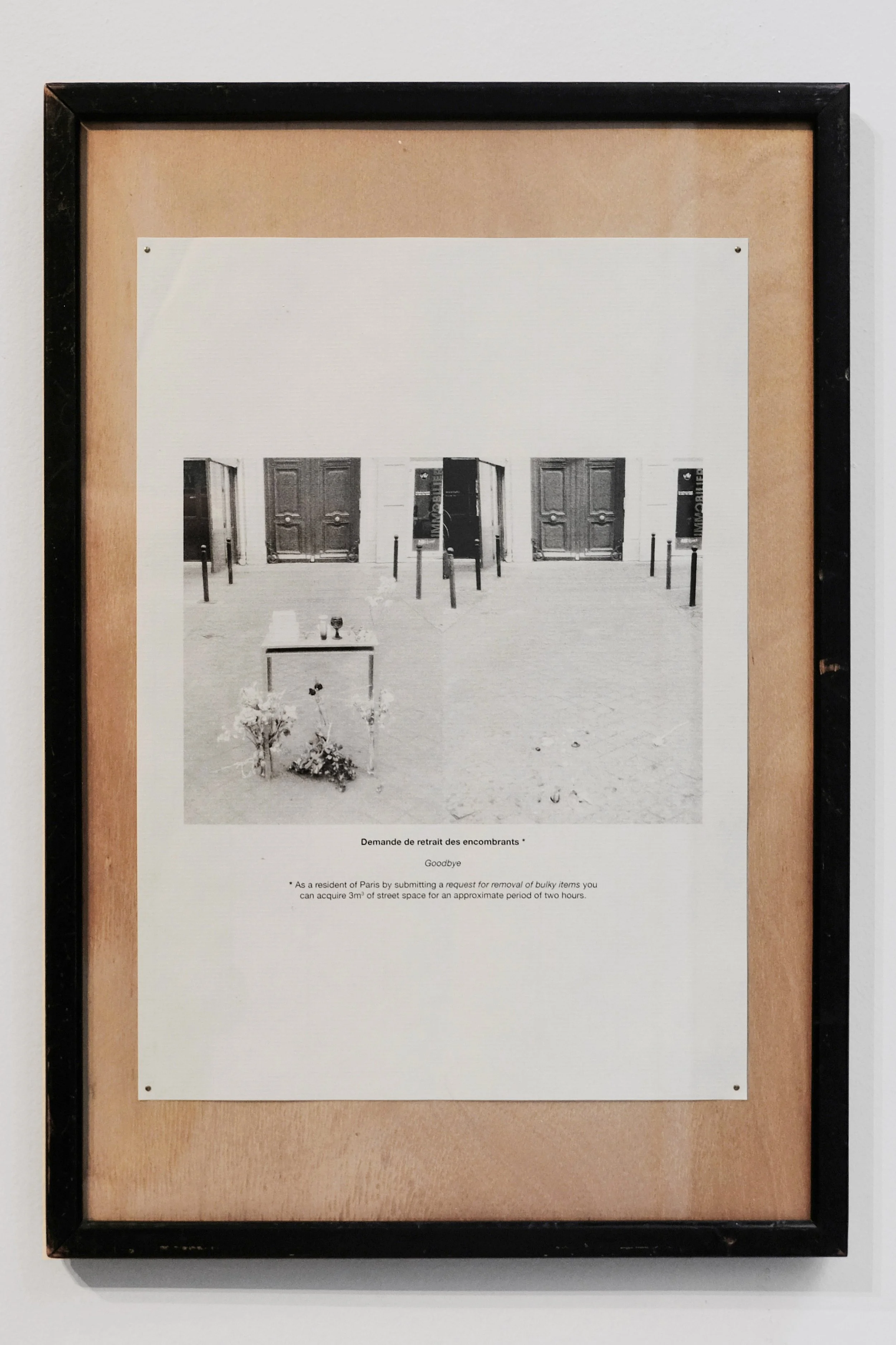
Demande de Retrait des Encombrants (Goodbye), 2023-2026, found frame, brass nails, inkjet on paper
#4 Can you tell us more about your project Spill, your café intervention in Manchester, and the intention behind it? How did you approach observing, documenting, and interacting with that specific social space using instructional letters and coasters?
Taome came across my publications at the Bound Art Book Fair in Manchester and invited me to do something at the café. I feel strongly concerned with how art interacts with its surroundings, so I wanted to seize this opportunity as a challenge. I asked myself what kind of work can I make that would make sense to show here? In this sense, the work was born out of the place.
To sit with a cup of coffee is one of the greatest pleasures for me. I wanted to offer this pleasure to other people. I made fifteen instructional letters and sent/gave them to friends and acquaintances without any explanation. The letter was folded several times and each unfolding revealed a new instruction. The letter led its recipient (with the tossing of a coin) to a cup of coffee, asked them to write something, and finally to post it back to me.
I think I received nine of the letters back. One was lost in the mail and another was delayed. I took fragments of each response to create coasters that were then used in the café for the duration of the exhibition. The letters were framed and exhibited.
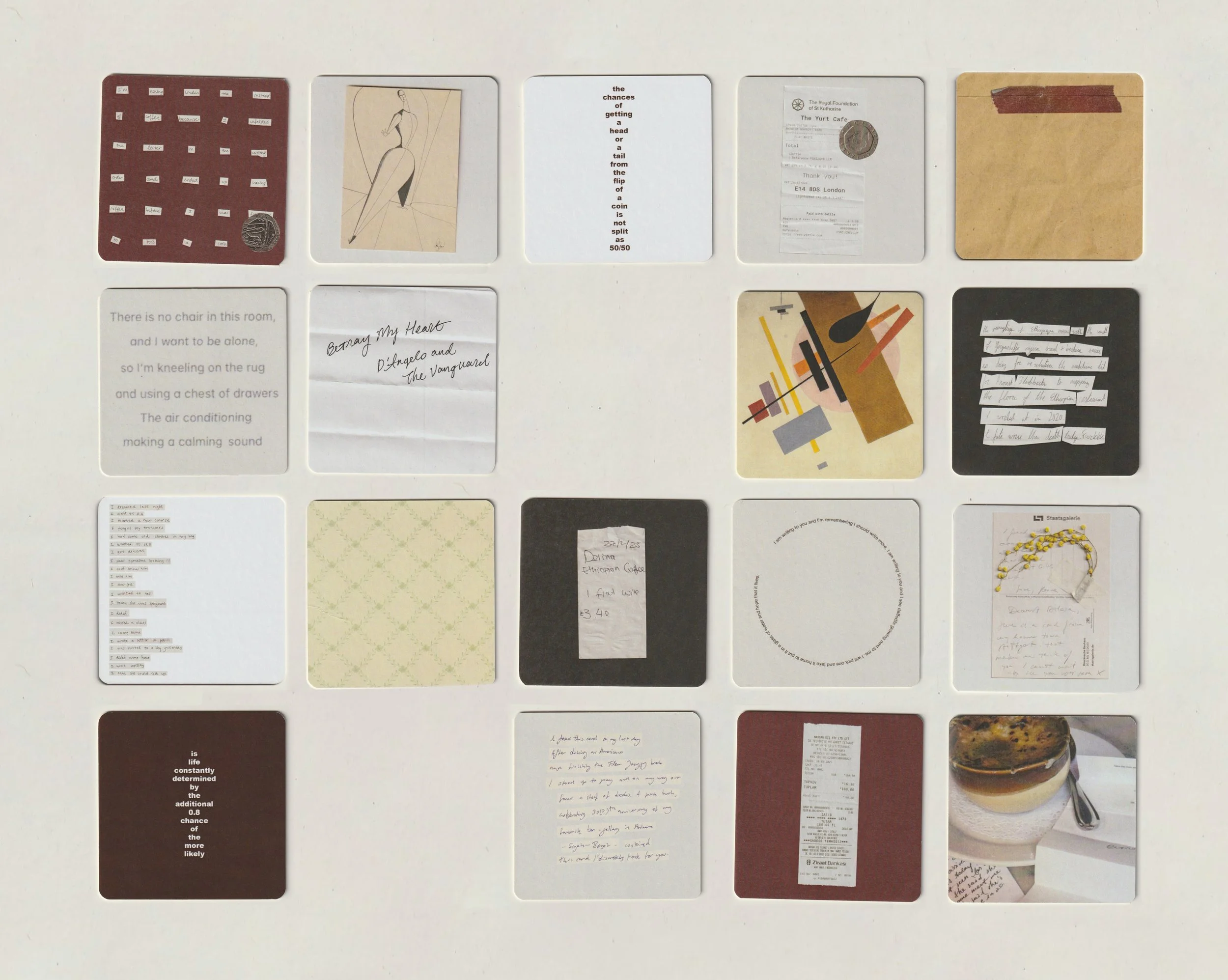
Coaster Scans, 2025
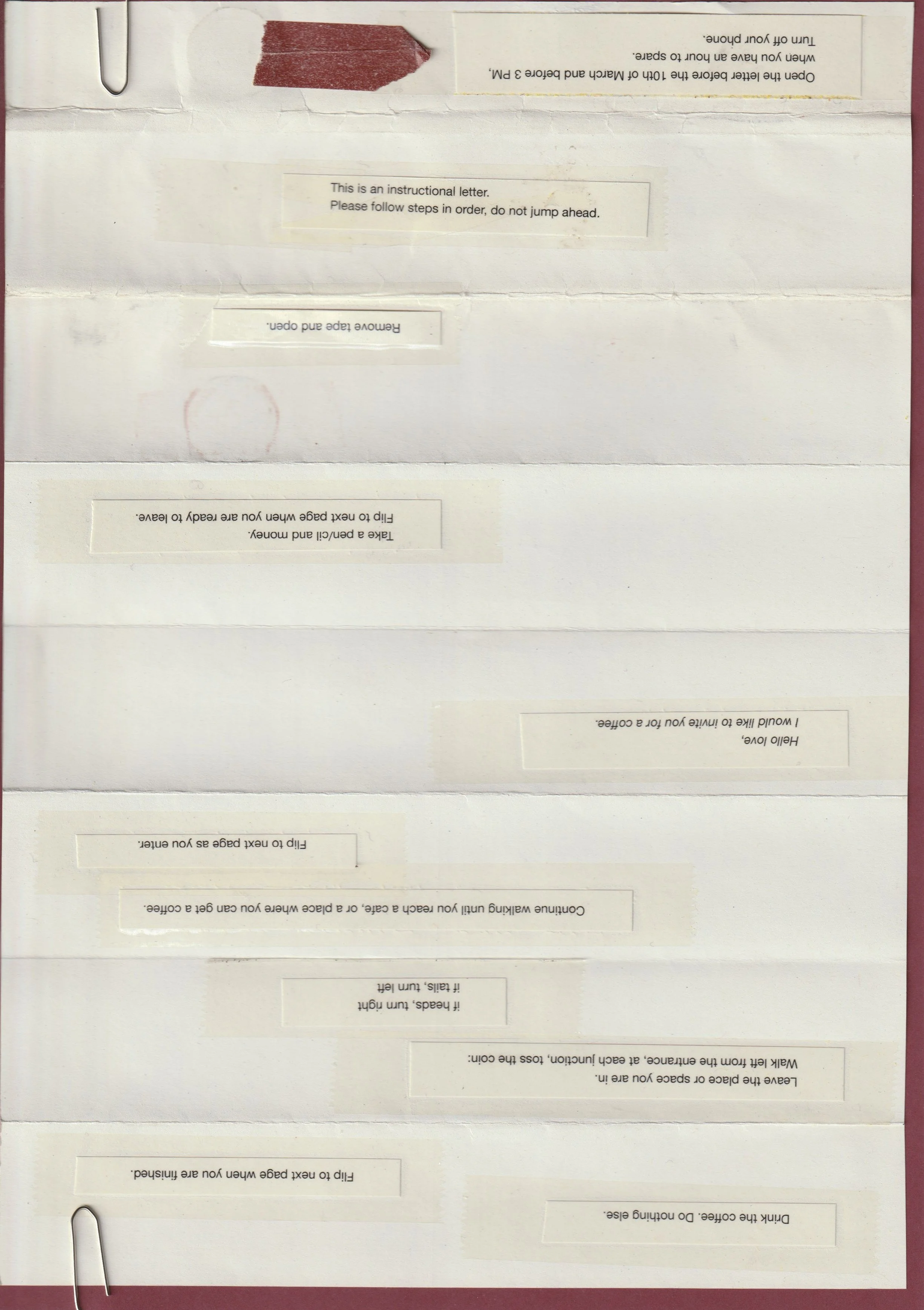
Instructional Letter Scan, 2025
#5 You have been the Art Director of New Papers since its beginning. How have you shaped its visual identity across the magazine, recitals, and online presence, and what do you enjoy most about this process?
My involvement started with the design of Loiter, the typeface in which all titles are written inside the magazine, the design of the magazine followed shortly after, and when it was decided that the launch of the magazine would be accompanied by its cover-to-cover reading, I suggested that there should be a stage design.
I was thinking about the scarcity of opportunities to design a large space in London for both artists and architects. If the opportunity is ever there, it is perhaps too serious. Something about the fact that the staging has to be set up in six hours on the day of the recital and deinstalled right after, within thirty minutes, makes it very exciting. I guess the thrill is what I enjoy the most.
Em (Illustrating Editor), Colton (Founding Editor), and I made the first Instagram post together. It comprises a drawing by Em on a waitress pad that is then printed over by an inkjet printer. Between attempting various printing techniques, drawings, type formats etc. we made about forty versions of the same thing, which have now been assembled as a book. This fastidiousness that exists in all aspects of the magazine is also very satisfying.
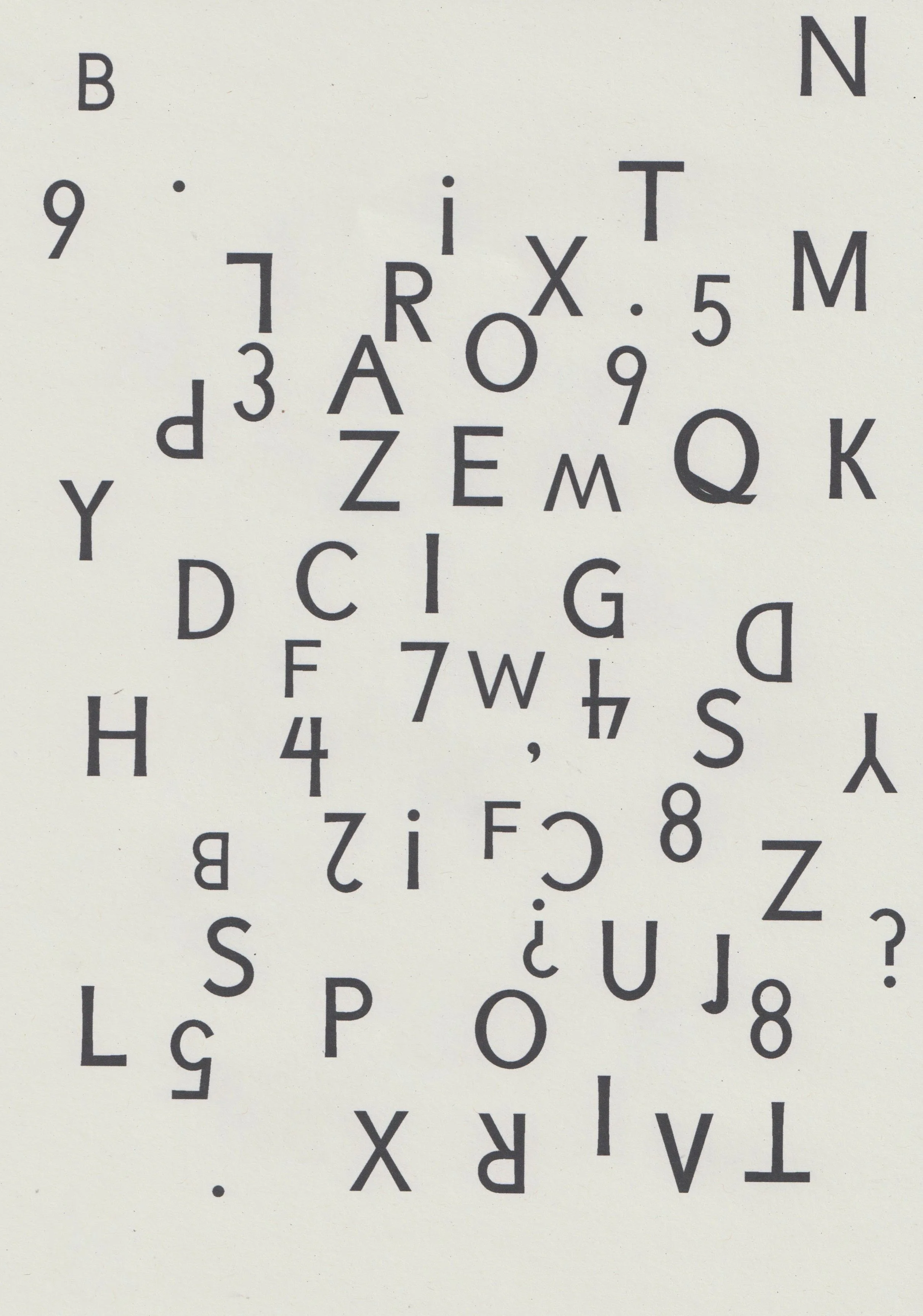
Loiter for New Papers, 2024-2026
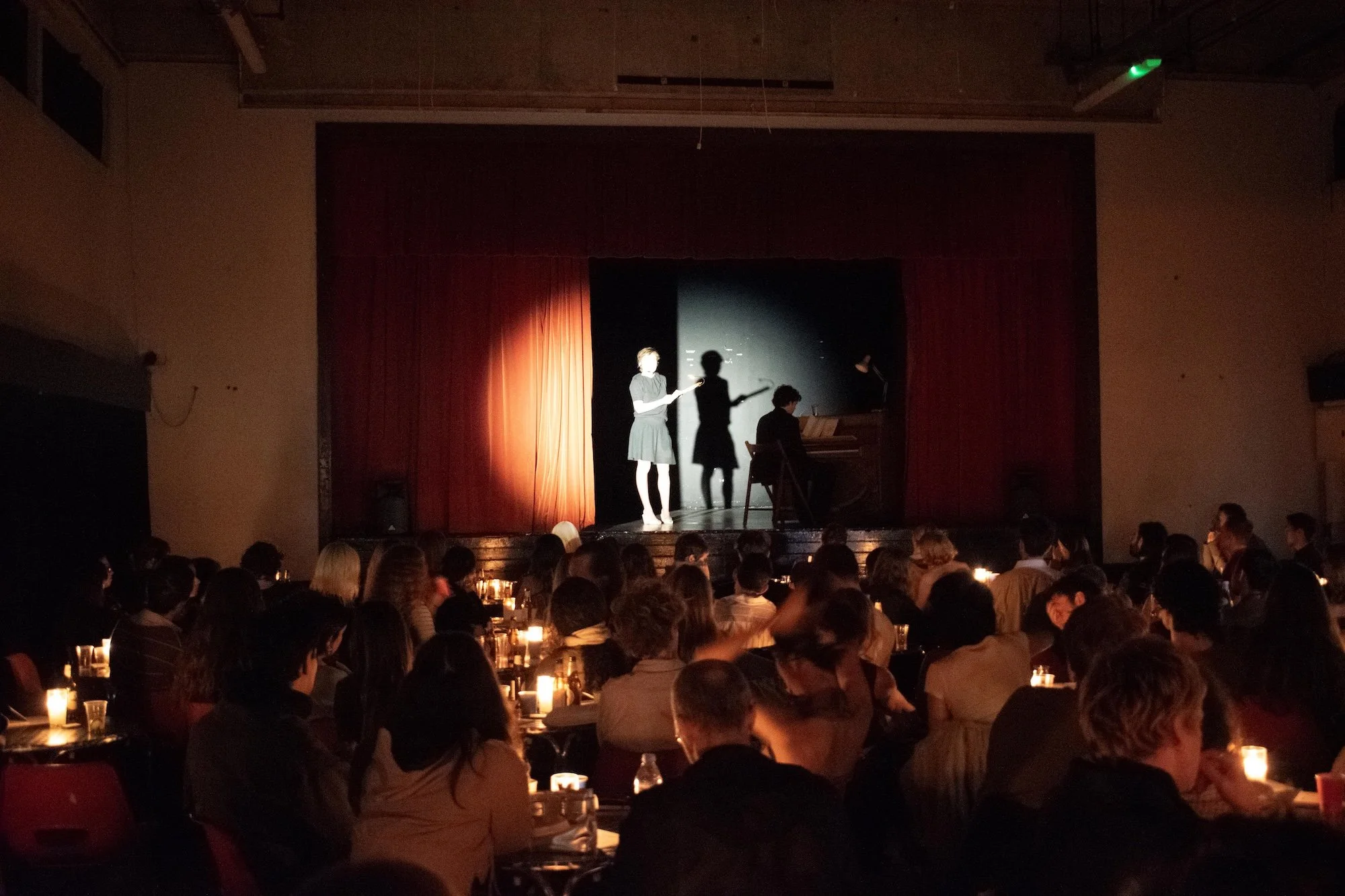
New Papers 4 Recital (Stage Design: Tamir Aharoni), 2025
#6 In Place Test #1, you explore how architecture in Kars carries layered histories through everyday items like keys, local cologne, and old folk music CDs. How do you choose these specific objects to test and reveal the hidden atmosphere of a place?
Kars remained under Russian occupation for forty years, during this period several buildings were constructed in the northern Russian style, having dramatic façades decorated with false columns and raised stones. Some of these buildings are now used as municipality spaces which anyone can enter. During my visit to Kars, I started to document their interiors, which were grand in their proportions, but very simple in their inhabitation. There was an elementary attentiveness to the spaces, most of them having few carefully placed furniture or objects and were well maintained and very clean.
Place Test #1 responded to the often unused courtyard within Indigo + Madder. Its materiality and proportions evoked a similarity to the repurposed Russian buildings in Kars. I was drawn to bridge the gap in their atmosphere through architectural gestures and the placement of objects.
The installation includes two photographs: a box of keys and a kitchen window, printed life-size. The keys are framed in a box frame, made to resist weather, mimicking the box of the keys in Kars. I painted the walls of the courtyard light-yellow up to shoulder height and continued the painted horizon over the glazing by the addition of frosted film. Half-painted walls occur commonly in the municipal buildings as an attempt of negotiating and domesticating the tall ceiling height. I selected the objects with Turkish households in mind: a bottle of Uludağ lemonade, lemon cologne, a C-D of Turkish folk music from my visit, and the photograph of a local patisserie placed within a found frame.
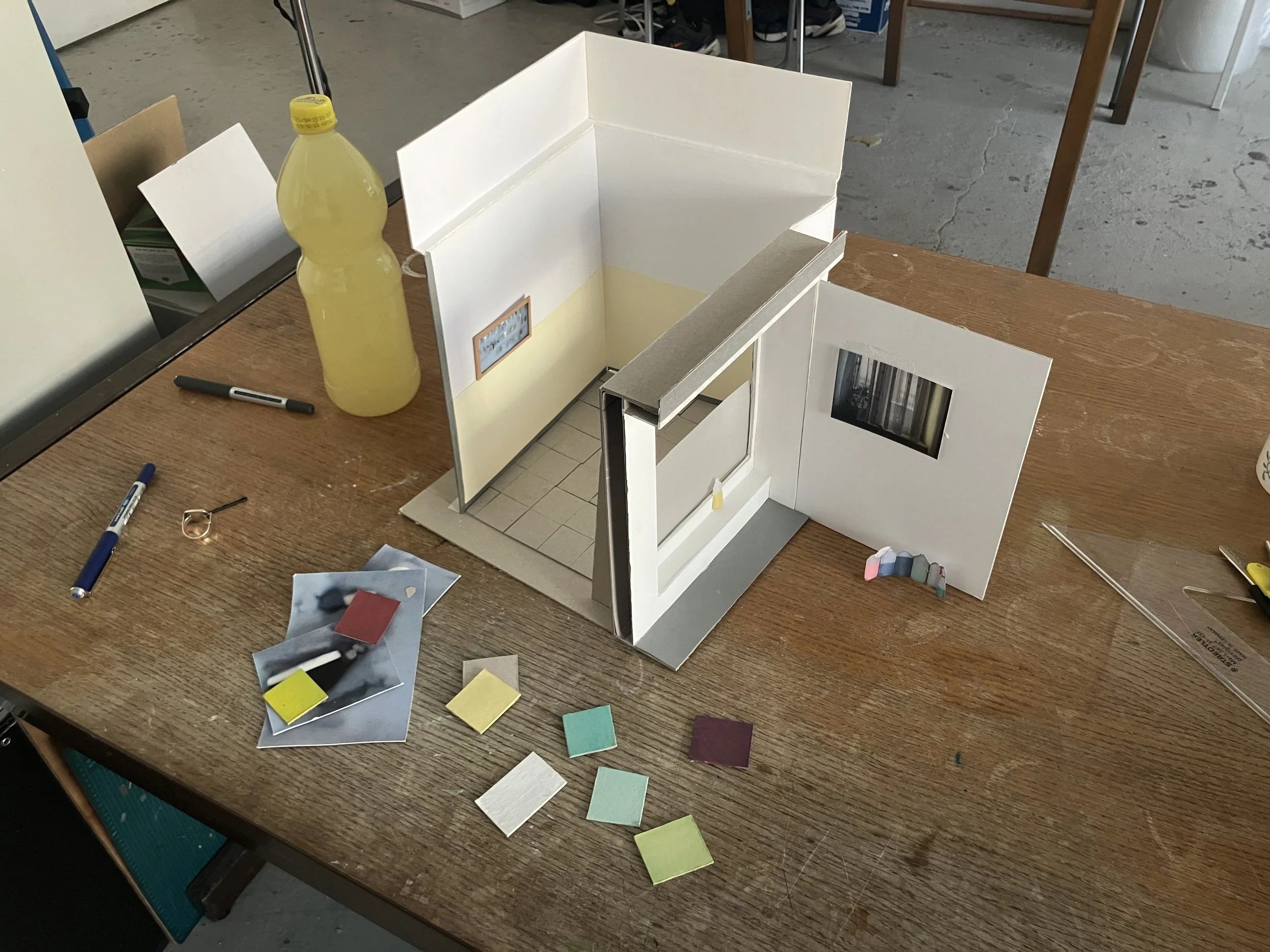
Place Test #1 Model, 2025
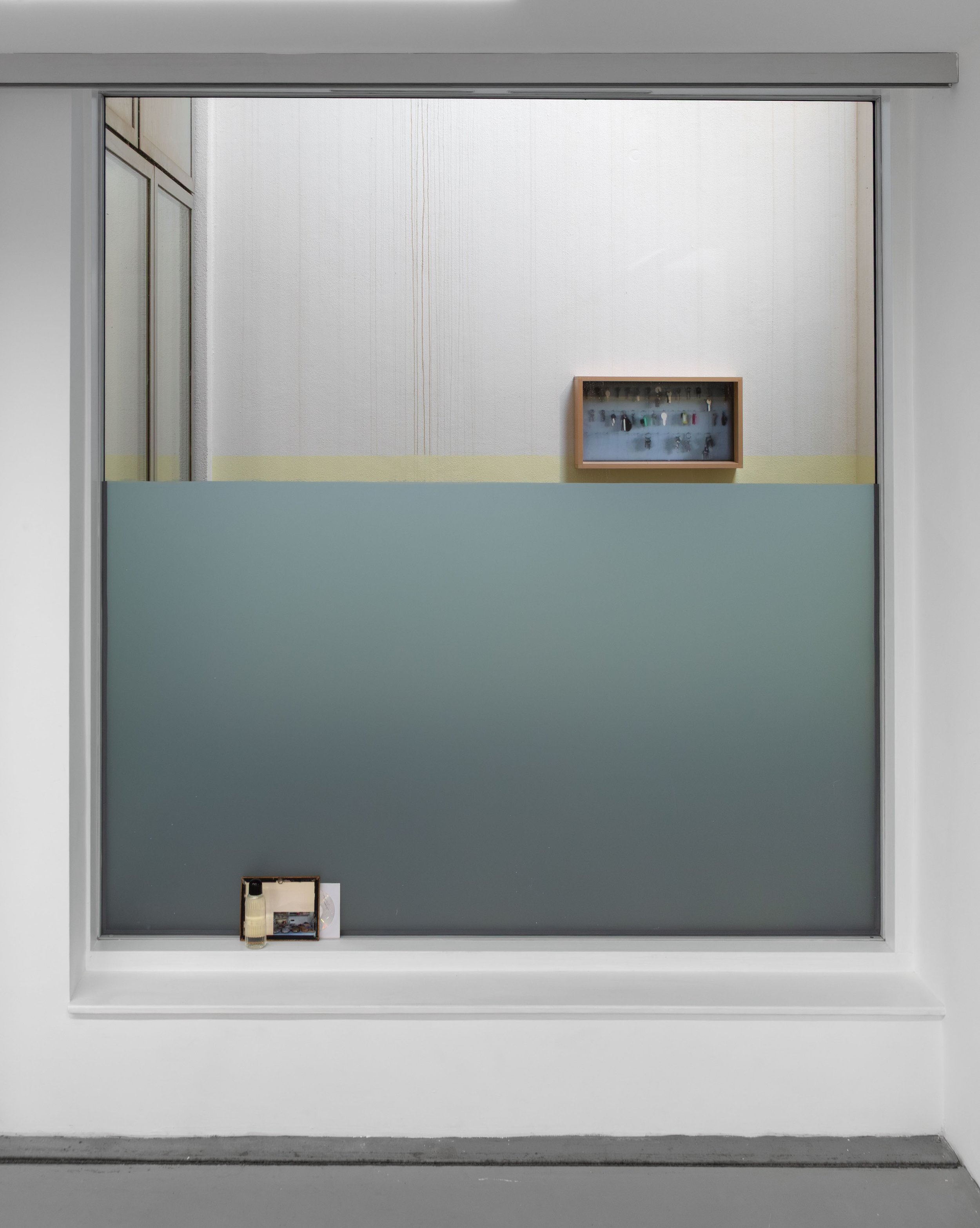
Place Test #1 (detail shot), 2025, dimensions variable, site specific installation comprising: Keys [2025, digital print on 310gsm museum grade matte paper, 348x665mm beech frame with museum glass, clear polyurethane varnish, rebate glazing seal], Window Piece [2025, digital print on 310gsm museum grade matte paper, 8mm Clear Cast acrylic cut to 680x840mm, four L-shaped screws], Light Yellow paint, Opal White frosted film, Uludağ lemonade bottle, Double Glazed 2 [2025, two digital prints on glossy paper, found double-sided frame with mounting paper], Eyup Sabri Tuncer lemon cologne, Seçme Türküler (Selected Turkish Folk Songs) CD. Image courtesy of Indigo + Madder.
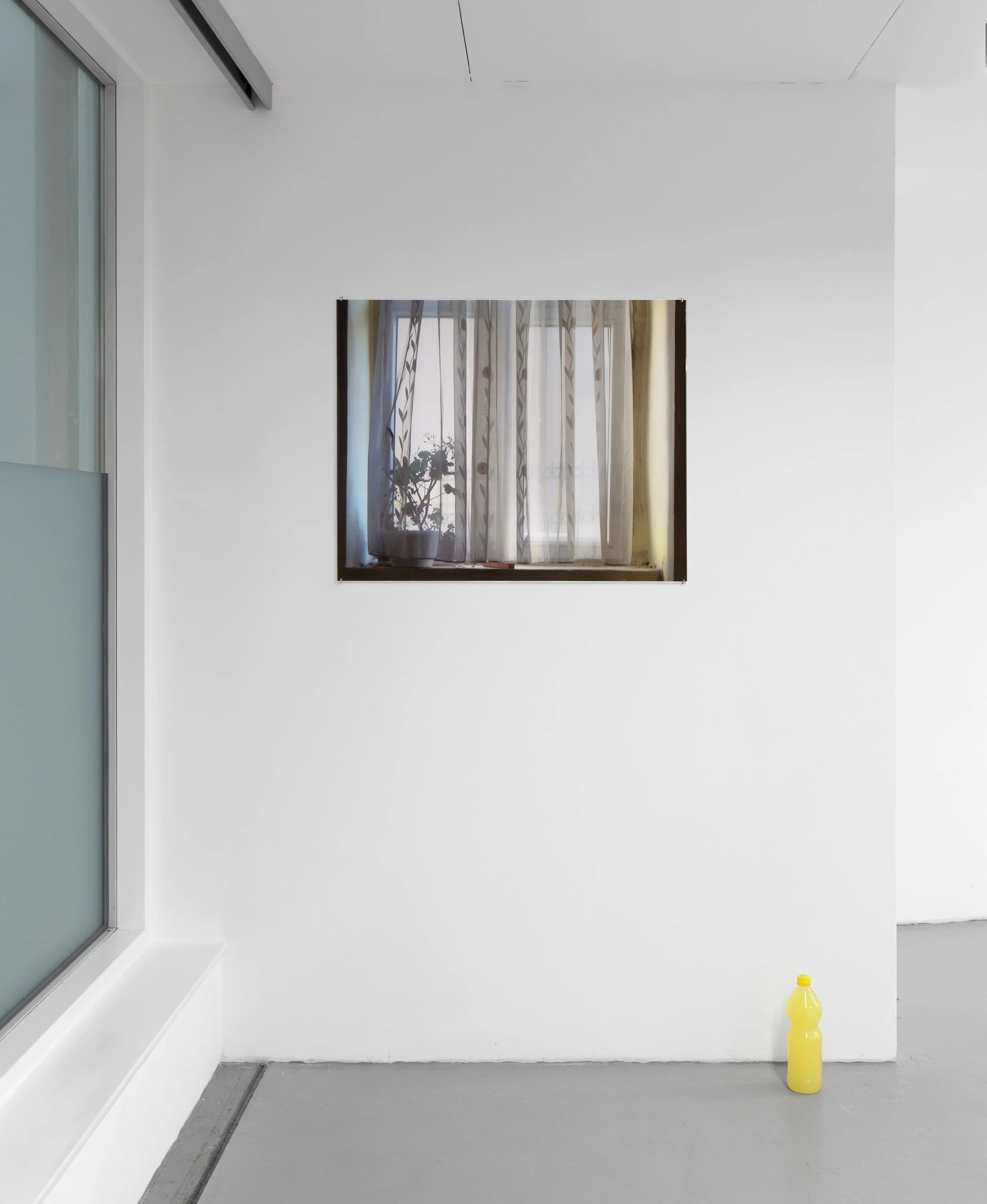
Place Test #1 (detail shot), 2025, dimensions variable, site specific installation comprising: Keys [2025, digital print on 310gsm museum grade matte paper, 348x665mm beech frame with museum glass, clear polyurethane varnish, rebate glazing seal], Window Piece [2025, digital print on 310gsm museum grade matte paper, 8mm Clear Cast acrylic cut to 680x840mm, four L-shaped screws], Light Yellow paint, Opal White frosted film, Uludağ lemonade bottle, Double Glazed 2 [2025, two digital prints on glossy paper, found double-sided frame with mounting paper], Eyup Sabri Tuncer lemon cologne, Seçme Türküler (Selected Turkish Folk Songs) CD. Image courtesy of Indigo + Madder.
#7 How do you see the role of an architect in today's society?
I think the most important duty of the architect is to be context aware and context responsive. It can be tempting to be consumed by one’s own vision of what should be built, especially when the workload to realise the vision is so labour intensive, but it is essential to consider the lifespan of architecture and its implications to its inhabitants and surroundings aesthetically, environmentally, politically, and socially.
#8 How does your environment influence your work?
Much of my practice is about observation which requires distancing, so it is important that I can return to somewhere I feel at home, both in the studio and in my bedroom. They exist on similar axes and balance each other, one is always tidy and the other is messy.
For the most part I like to work in silence, when I read I appreciate some background noise. My current studio has fluorescent lights which in most contexts I would despise, but I have admittedly grown to love. They probably delay my sleep by at least an hour, because they make me feel very, very awake.
#9 Three things that inspire you at the moment?
Le Camion by Marguerite Duras, The Restaurant Window 1 by George Segal, and my Logan mount cutter.
#10 What do you currently read, watch, listen to?
I’m reading George Segal’s monograph by Jan Van Der Marck and The Writings of Marcel Duchamp. The last three films I watched are Je T’aime, Je T’aime, The Bourne Identity, and Ménage. I stopped carrying earphones to listen to the city and to my thoughts.
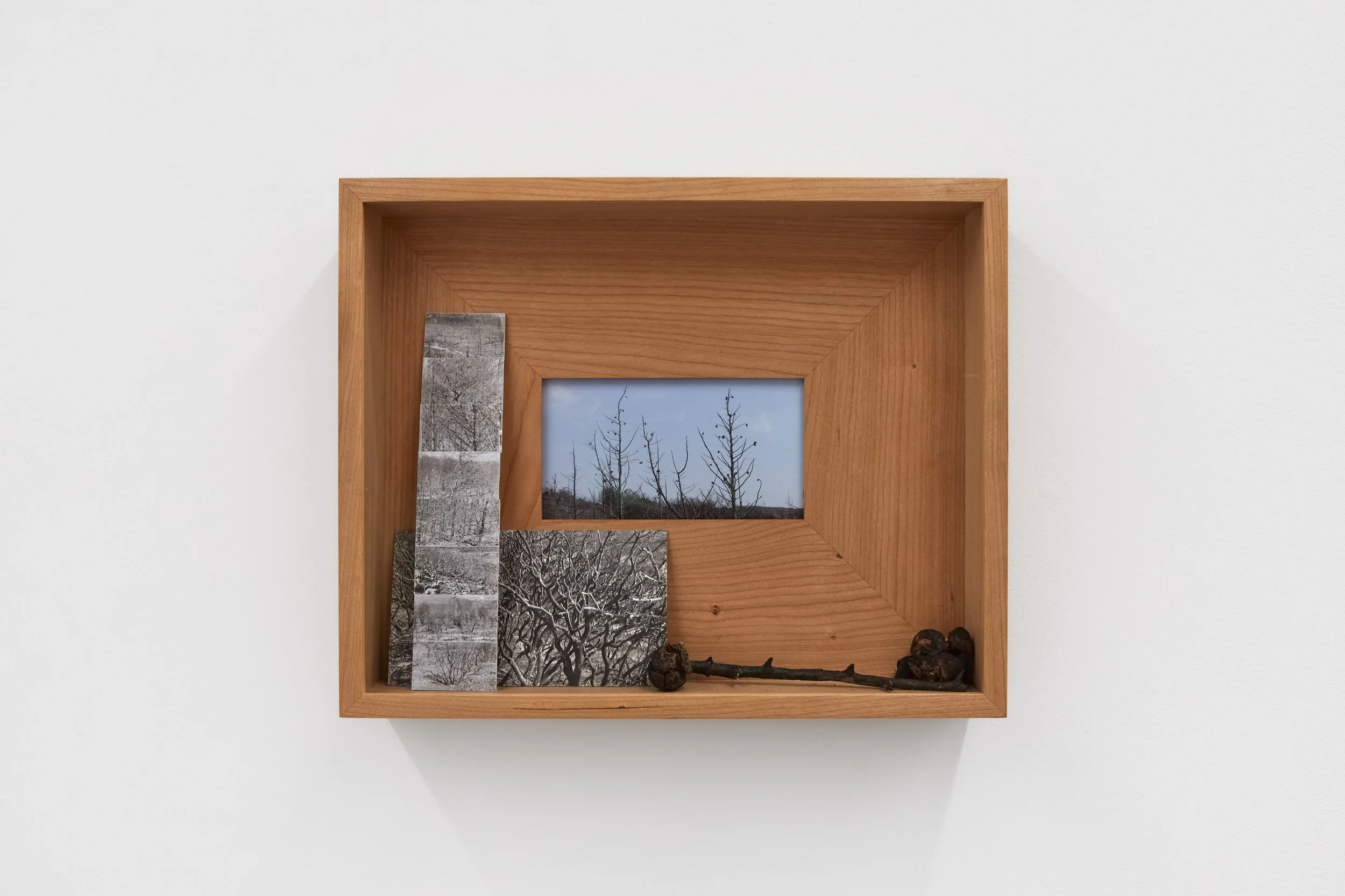
Double Glazed, 2024, 325x263x67mm, double-frame made from cherry with walnut splines, museum glass, two fine art prints on rag 80x141mm, chipped tree branch and cones from Alaçatı [burnt during fire on 17th of July 2024, collected August 2024], Stack (draft) [2024, eight inkjet prints on glossy paper 24x42mm mounted on board with acid-free double sided tape]. Image courtesy of Indigo + Madder.
Links
Instagram: @di.koz
Website: dikoz.online
Interview by Caroline Schulz